






Every garment begins as a pattern. Every seat cover, upholstered panel, and soft-goods component traces its origin to a series of technical decisions made long before a single piece of fabric reaches the cutting table. That foundational reality has not changed. What surrounds it has.
For decades, those decisions were made at the drafting table: rulers against paper, French curves guiding pencils, awls marking notches, and grading wheels stepping through size increments by hand. The workflow demanded precision, patience, and a depth of material knowledge that accumulated over years of practice. It was craftsmanship in the fullest sense, and it built entire industries.
Today, pattern makers are still expected to deliver accuracy, consistency, and speed. The timelines have shortened. The pressure to reduce physical sampling has increased. The number of stakeholders who require visibility into the development process has grown. The responsibility has not diminished; in many respects, it has expanded.
The tools have changed. The craft that drives them has not.

Understanding how pattern making tools have evolved is not an exercise in nostalgia. It is a practical examination of how each technological shift addressed a real constraint and what constraints remain for teams working at the intersection of design, production, and speed.
The Drafting Table: Precision Within Its Limits
Manual pattern making was defined by its strengths as much as its constraints. A skilled pattern maker working with paper and physical tools could produce work of exceptional accuracy. The craft demanded an intuitive understanding of how two-dimensional geometry translates into three-dimensional form, how fabric grain affects drape, how seam allowances interact with construction sequence, and how adjustments in one area of a pattern propagate through adjacent pieces.
That knowledge did not disappear when digital tools arrived. It was, and remains, the foundation of the profession.
The limitations of manual workflows were not a reflection of the people using them. They were structural. Every pattern revision required physical redrafting. Grading across size ranges was time-intensive and introduced cumulative risk of inconsistency. Pattern storage meant physical archives that could be damaged, lost, or degraded over time. Communicating a proposed change to a remote manufacturer meant descriptions, sketches, and phone calls, then waiting for a sample to confirm whether the adjustment had been interpreted correctly.
These were the conditions under which entire product lines were developed and delivered successfully for generations. The system worked. But as product cycles accelerated and global supply chains extended, the structural limitations of manual workflows became increasingly difficult to absorb.
The bottleneck was not talent. It was time, and the compounding cost of iteration.
The First Digital Revolution: Removing Repetitive Work
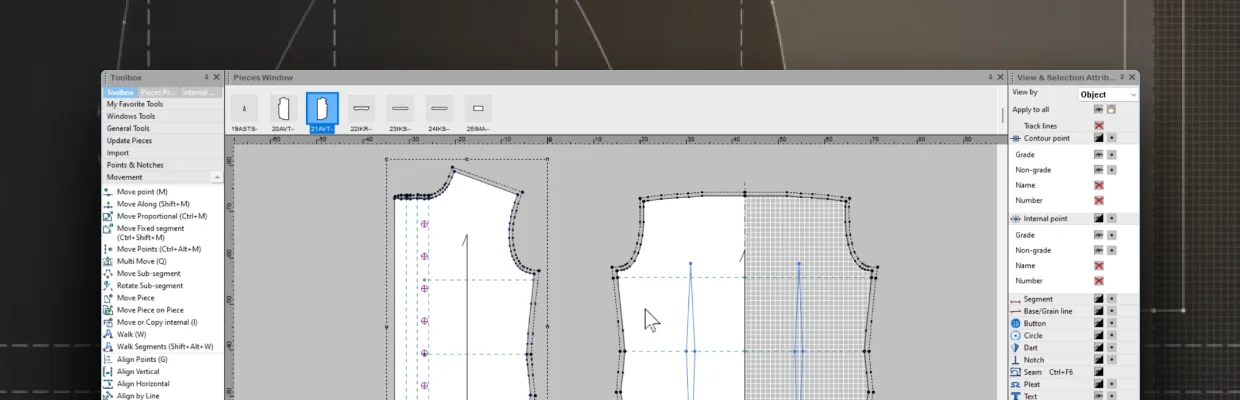
The arrival of computer-aided design in pattern making did not replace the expertise of experienced practitioners. It removed the most time-consuming repetitive elements of their work, freeing attention for the decisions that actually require professional judgment.
Digital pattern creation meant that a pattern could be stored, retrieved, and modified without redrafting from scratch. Grading automation applied size increments consistently across an entire pattern set. Libraries of reusable components reduced the time required to begin new development. Measurement tools improved accuracy by eliminating manual calculation errors. And when a revision was needed, the pattern itself could be edited directly rather than recreated.
- Patterns became editable without rebuilding from zero
- Grading became faster and more consistent across size runs
- Libraries of prior work became accessible and reusable
- Archiving shifted from physical storage to digital file management
- Communication of technical specifications improved through standardized file formats
The designer’s knowledge remained central. The software handled repetitive precision. That division of labor was the defining value of the first digital transition, and it remains the right framework for thinking about every technology shift that followed.
Pattern makers who adopted digital tools did not become less skilled. They became more productive, and their expertise was applied at a higher level of the workflow than before.
A New Bottleneck: The Validation Problem
Digital pattern making solved the creation problem. It did not solve the validation problem.
After CAD workflows became standard, pattern makers faced a set of challenges that the software had not yet addressed. A digital pattern could be produced and revised efficiently. But the fundamental question of whether a pattern would actually fit, drape correctly, and meet production requirements still required a physical sample to answer.
Creating the pattern became faster. Proving the pattern was still slow.
The sequence remained familiar: create the pattern, export the files, wait for the sample, review the fit, identify issues, revise the pattern, and repeat. In some development cycles, this loop ran three, four, or more times before a pattern was approved for production. Each iteration consumed time, material, and coordination effort. Each wait introduced the risk of compressing downstream timelines.
The bottleneck had simply moved. It was no longer in pattern creation. It was in the gap between creating a pattern and confirming that it worked.
Fit issues discovered late in development are significantly more costly to address than fit issues identified early. The pattern maker’s expertise had not changed. The workflow still prevented that expertise from being applied at the point where it could have the most impact.
Integrated 2D and 3D Workflows: Closing the Validation Gap
The next meaningful advance in pattern making was not simply the introduction of 3D visualization. Three-dimensional rendering had existed in design software for some time before it became genuinely useful as a pattern making tool. The shift that mattered was integration: connecting 2D pattern creation, 3D simulation, revision, and fit evaluation inside a single, continuous workflow.
The distinction is significant. A standalone 3D visualization tool requires exporting a pattern piece, importing it into a separate environment, reviewing the result, returning to the pattern software to make revisions, exporting again, and repeating. That sequence adds steps and introduces the possibility of version inconsistencies between files.
An integrated workflow eliminates those steps. A change made to the pattern in 2D is reflected immediately in the 3D visualization. Fit analysis happens during product development, not after it. The pattern maker can identify a sleeve cap issue, adjust the seam line, and observe the effect on drape without leaving the working environment or waiting for an external process to complete.
Faster Iteration
When 2D pattern and 3D simulation exist in the same environment, the time between making a decision and seeing its consequence collapses. Adjustments that previously required a new sample to evaluate can be assessed digitally within the same working session. Development cycles that once required multiple physical prototypes to resolve fit issues can now reach a much higher level of confidence before a single sample is produced.
Reduced Sampling Costs
Physical sampling serves a purpose. It should serve the purpose of final validation, not discovery. When an integrated workflow allows fit and construction issues to be identified and resolved digitally, physical samples can be reserved for confirmation rather than exploration. The number of required prototypes decreases. The cost per approved design decreases alongside it.
Improved Communication Across Teams
Physical samples travel. Digital garments do not. When a pattern maker makes an adjustment in an integrated 2D and 3D environment, the updated visualization is immediately available for review by designers, technical developers, and manufacturing partners regardless of location. All stakeholders review the same digital artifact. Interpretive gaps between a description of a proposed change and the change itself are reduced substantially.
This is particularly relevant for development teams working across multiple time zones, or for brands that rely on manufacturing partnerships in different regions. The digital garment becomes a shared reference that does not require physical delivery to communicate.
For organizations managing large seasonal volumes or operating under compressed development timelines, the cumulative impact of reduced sampling is significant. It is not simply a cost reduction. It is a structural change in how development time is allocated.
Technology Serving Craftsmanship
It is worth addressing directly the concern that some experienced pattern makers carry, even if it is rarely stated explicitly: that advances in digital tooling reduce the value of accumulated expertise.
They do not.
Software does not make fit decisions. It does not understand how a particular fabric’s weight will affect the hang of a collar, or how a seam allowance adjustment will interact with construction sequence at the manufacturing stage, or how a garment that fits correctly on a digital model will behave differently on a range of body types in motion. Those judgments belong to experienced pattern makers. They always have.
What integrated workflows change is the distribution of effort within the professional’s working day. Less time is spent on mechanics: moving notches, recalculating measurements, coordinating revisions across separate tools. More time becomes available for the technical decisions that actually determine whether a product is well-made: fit, balance, construction logic, and manufacturability.
Technology expands the capacity of experienced professionals. It does not substitute for the judgment that defines their work.
This has been true of every meaningful advance in pattern making tools. The French curve did not replace the knowledge of how a sleeve should fit. CAD did not replace the expertise required to grade a pattern intelligently. Integrated 2D and 3D workflows do not replace the professional who understands why a particular adjustment is necessary. They extend what that professional can achieve within a given development cycle.
An Industry-Wide Shift
The movement toward integrated digital workflows is not limited to apparel. Across furniture, automotive interiors, technical textiles, and other soft-goods industries, the same pressures are reshaping development expectations. Shorter cycle times, sustainability requirements that favor reduced material waste, increasingly distributed supply chains, and rising expectations for collaboration across functions are not sector-specific challenges. They are universal ones.
Organizations in each of these industries are finding that connected digital development environments address multiple pressures simultaneously. They reduce the time between design intent and production-ready specification. They create a shared reference that can be reviewed across functions without physical distribution. They identify problems earlier, when correction is less costly. And they reduce the volume of physical prototypes required to reach production approval.
The adoption of integrated workflows is, in this sense, a response to business conditions as much as it is a response to technological capability. The tools became available at the moment the industry needed them.

Optitex PDS: Designed Around Professional Pattern Making
Optitex Pattern Design Software (PDS) was developed around the daily realities of professional pattern makers, not around a generalized vision of what design software should look like. The architecture of the platform reflects a specific understanding of how experienced practitioners actually work and what currently interrupts that work.
Pattern makers working in Optitex PDS can build, modify, and evaluate garments within one connected environment. Changes made in 2D update immediately in 3D, enabling fit analysis throughout the development process rather than only after physical sampling. Everything stays connected within a single environment, from first draft through to final specification.
The platform supports the full range of pattern development activities: initial construction, grading across size runs, library management, annotation, and technical specification output. The integration of 2D pattern making with 3D visualization is built into the foundation of the platform, connecting every stage of the workflow from construction through validation.
Virtual fit models allow pattern makers to evaluate fit across size ranges and body types without producing physical samples for each combination. Synchronized updates mean that a revision made in response to a fit observation is immediately visible, allowing the evaluation to continue rather than pausing for a new render cycle.
The result is a development environment in which the pattern maker’s expertise operates at the center of the process, supported by tools that reduce the time and effort required for mechanics and extend the time available for judgment.
For teams working across fashion, apparel, furniture, and automotive interiors, the platform provides a consistent workflow framework that scales with product complexity and development volume. The emphasis throughout is on removing friction between decisions, not on adding process.
The Craft Remains. The Possibilities Continue to Grow.
Every advance in pattern making tools has followed the same underlying logic: identify the constraint that limits the application of professional expertise, and remove it. The drafting table made precision possible within the limits of manual work. Digital pattern making expanded efficiency by automating repetitive tasks. Integrated 2D and 3D workflows now address the validation constraint that digital drafting left in place.
The profession has not been simplified by these advances. It has been elevated. Pattern makers who work within integrated development environments are not doing less skilled work. They are applying their skills at more stages of the development process, with greater visibility into the consequences of their decisions, and with fewer interruptions between an adjustment and its evaluation.
The future of pattern making is not about replacing expertise. It is about giving experienced professionals greater precision, greater visibility, and greater confidence throughout product development.
The drafting table represented a commitment to accuracy at a moment when accurate tools were difficult to produce. That commitment remains unchanged. The tools that serve it continue to evolve, and the professionals who have built careers on deep technical knowledge are better positioned than ever to use them.