






Frankfurt, Germany – Texprocess 2026 revealed a fundamental shift in how the sewn products industry approaches digital transformation. What emerged across four days of demonstrations, conversations, and competitive observation was not simply incremental progress in individual technologies, but rather a decisive movement toward integrated systems that connect design, end-product development, and production preparation into unified workflows.
The event, held in Frankfurt from April 21-24, attracted international attendance with a notably strong European presence, particularly among German manufacturers and product development teams. The composition of attendees and the nature of their inquiries suggested that brands and manufacturers are no longer evaluating digital tools as isolated capabilities. Instead, they are seeking comprehensive solutions that address efficiency, waste reduction, and speed to market as interconnected operational imperatives.
Pattern Making and 2D to 3D Integration Draw Sustained Interest
While the show floor conversations spanned a range of topics, pattern development and its link to three-dimensional prototyping emerged as a clear point of interest. Visitors were particularly drawn to demonstrations that presented pattern making, grading, and 3D simulation as a seamless, integrated workflow.
This interest reflects operational realities in contemporary product development. Pattern accuracy directly impacts material utilization, fit quality, and production viability. When pattern data translates seamlessly into 3D visualization, teams gain the ability to validate designs before committing to physical samples. The reduction in sampling iterations translates to measurable time and material savings, a calculation that resonates across apparel, automotive interiors, and home furnishings sectors.
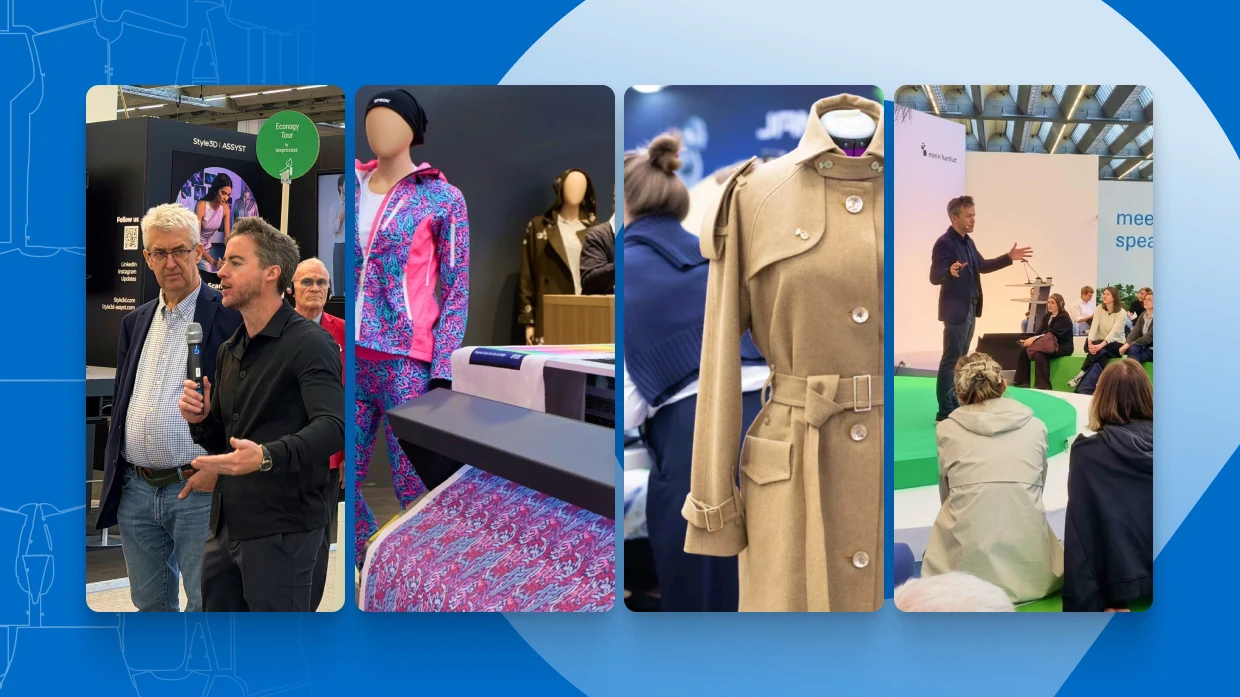
The enthusiasm for these integrated workflows was particularly evident in demonstrations that showcased the transition from two-dimensional pattern construction to three-dimensional garment simulation without requiring data reconstruction or file migration. Attendees frequently requested repeat demonstrations of these capabilities, indicating that the value proposition had immediate practical relevance to their current production challenges.
Sustainability Emerges as Economic Imperative, Not Compliance Exercise
Texprocess 2026 positioned sustainability not as an aspirational goal but as a quantifiable business driver. On April 22, Optitex and NedGraphics presented on the main stage of the Texprocess Forum to demonstrate how connected workflows reduce waste while improving productivity. The presentation, delivered by James McDermott, Sales Manager for both brands, illustrated the tangible impact of integrating textile design, pattern development, and production preparation. The session drew significant attention, with attendees closely engaging and capturing key insights for later reference.
The strength of this reception led to Optitex and NedGraphics being selected for the event organizers’ Econogy Tour, a curated initiative highlighting sustainability’s role in business success. The term Econogy itself, merging economy and ecology, captured the industry’s evolved understanding that environmental impact and operational efficiency are now inseparable considerations. McDermott presented again on April 24 as part of this showcase, reinforcing the message to additional visitors at the booth.
The crowd response from both presentations suggested that brands and manufacturers are actively seeking solutions that deliver both sustainability credentials and operational advantages. Waste reduction through improved marker efficiency, decreased sampling requirements, and accurate first-time pattern development are no longer viewed as separate from environmental goals. They represent the same outcome achieved through better digital tools and process integration.
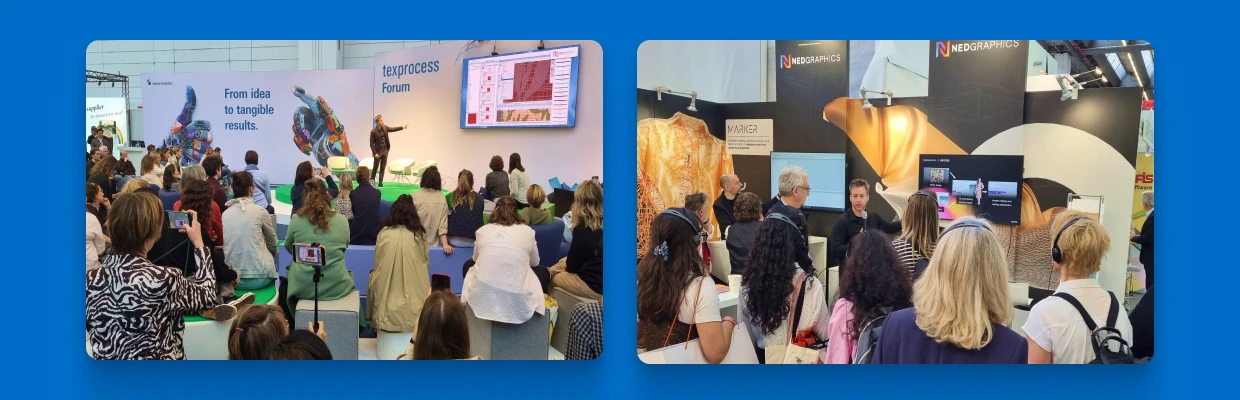
This convergence of economic and ecological priorities signals a maturation in how the industry evaluates technology investments. Solutions must now demonstrate clear returns in both material utilization and production efficiency to justify implementation.
Connected Workflows Become Standard Expectation
Perhaps the most significant observation from Texprocess 2026 was the shift in baseline expectations. Visitors no longer inquired whether systems could integrate with their existing tools. Instead, they asked how seamlessly that integration functioned, what data transferred between platforms, and how much manual intervention remained necessary.
This evolution from “can it connect” to “how well does it connect” represents a fundamental change in procurement criteria. Companies are evaluating not just the capabilities of individual software modules but the completeness of the ecosystem those tools inhabit. A pattern-making system that exports clean data to 3D visualization, marker-making, and production planning tools holds greater value than more sophisticated standalone software that requires extensive data preparation at each workflow transition.
This is also where integrated software ecosystems demonstrated clearer operational relevance. When textile design and product development systems operate within a connected framework, the continuity of data becomes measurable. For example, textile assets created in NedGraphics can move forward with preserved color accuracy, repeat structure, and material intent, directly informing downstream processes in Optitex such as digital patternmaking, 3D prototyping, and marker file creation. Rather than treating each stage as a separate task requiring translation or rework, the workflow functions as a single, continuous data stream, reducing friction between creative and technical teams while maintaining consistency across outputs.
One Workflow for Textile, Product Development and Final Approval: Optitex & NedGraphics
The emphasis on connected workflows also appeared in discussions about collaboration across distributed teams. As product development increasingly involves participants across multiple locations and disciplines, the ability to work from shared digital assets without version conflicts or file conversion issues has become operationally critical.
Industry Direction and Strategic Implications
The patterns observable at Texprocess 2026 indicate that the sewn products industry has reached an inflection point in digital adoption. Early-stage experimentation with isolated digital tools is giving way to deliberate implementation of integrated systems designed to support complete product development cycles.
Manufacturers are prioritizing solutions that deliver measurable outcomes in production efficiency, material utilization, and time to market. Sustainability is no longer treated as a separate initiative but as an expected outcome of better digital processes. The combination of these pressures is driving demand for platforms that connect design, technical development, and production preparation into coherent workflows. In practice, this is reflected in paired environments where textile creation and end-product engineering are no longer siloed.
Textile design developed in NedGraphics can inform downstream technical processes in Optitex without requiring reinterpretation, enabling a more direct path from visual concept to production-ready specification. This continuity reduces material waste, minimizes sampling iterations, and supports more accurate decision-making earlier in the development cycle.
For companies operating in this space, the implications are clear. Technology investments must demonstrate both immediate operational value and long-term scalability. Systems must integrate effectively with the broader digital ecosystem rather than functioning as isolated applications. And sustainability credentials must be backed by quantifiable efficiency gains, not simply environmental messaging.
Looking Forward
Texprocess 2026 provided confirmation that the industry is moving decisively toward comprehensive digital workflows. The technologies that generated the most substantive interest were those that reduced friction between design intent and production execution, that eliminated redundant manual processes, and that enabled better decisions earlier in the development cycle.
Optitex and NedGraphics continue to support this industry evolution through solutions that connect: textile design, pattern development, 3D prototyping, and production preparation into unified workflows. The collaboration with NedGraphics further strengthens this offering by integrating textile design capabilities into the broader product development ecosystem.
The path forward is not about adopting individual technologies but about implementing complete systems that transform how products move from concept to production. That understanding now drives decision-making across the sewn products industry, and it will shape technology development and implementation strategies for years to come.
If these insights reflect the challenges and priorities you are seeing across your own workflows, share this article with your network on LinkedIn and contribute to the broader industry conversation around connected, production-ready digital ecosystems.
Your perspective helps shape how the industry defines its next standard.